
AI in Academic Research: Smarter Research Methodology, Data Interpretation & Journal Formatting for Researchers and Academicians
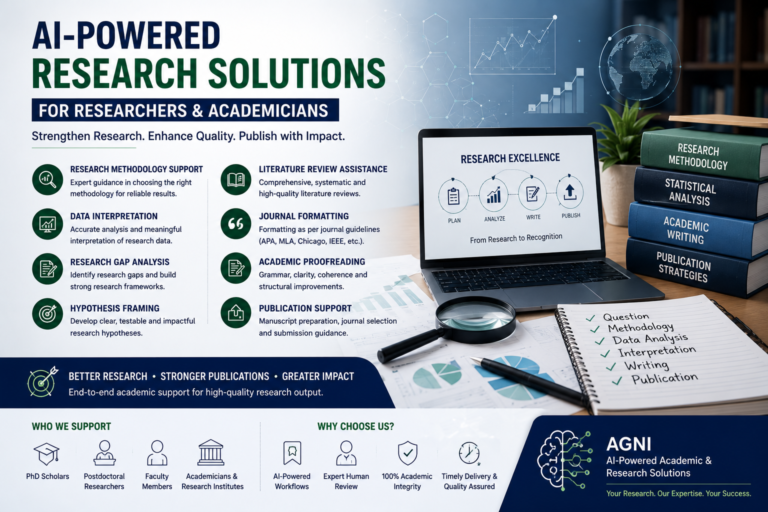
The Research Ecosystem Is Rapidly Evolving
Academic research is changing faster than ever before. Researchers, scholars, faculty members, and academicians are now working in an environment where artificial intelligence, digital databases, structured workflows, and data-driven systems are becoming essential parts of modern research.
From research methodology development to journal formatting and academic proofreading, professionals are increasingly searching for smarter ways to manage research quality, publication workflows, and documentation standards. Searches related to “AI in academic research,” “research methodology support,” “journal formatting services,” and “academic proofreading” continue to grow as institutions and researchers adapt to modern research systems.
Today, the focus is no longer only on producing research papers. The focus is on creating structured, accurate, ethically developed, and professionally formatted research that meets global academic standards.
Why Modern Research Workflows Have Become More Complex
Research today involves much more than writing a paper. Researchers are expected to identify research gaps, build strong hypotheses, select appropriate methodologies, manage data interpretation, follow strict citation standards, and prepare publication-ready manuscripts for journals and conferences.
At the same time, academic publishing standards are becoming more competitive. Poor formatting, weak methodology, inconsistent referencing, and unclear research structure can reduce the impact and credibility of valuable research work.
This is why many academicians and scholars are now adopting AI-assisted research workflows to improve efficiency, organization, and research quality while maintaining academic integrity.
How AI Is Supporting Researchers and Academicians
Artificial intelligence is helping researchers organize and streamline academic workflows more effectively. Modern AI-powered systems can assist with research structuring, literature organization, citation management, grammar refinement, data summarization, and journal formatting.
For researchers handling large volumes of information, AI-assisted systems help reduce manual workload and improve workflow efficiency. This allows scholars to spend more time on analysis, critical thinking, and knowledge development rather than repetitive formatting tasks.
At AGNI, AI is used to support human expertise rather than replace scholarly thinking. Every research workflow combines structured analysis, AI-assisted productivity, and human-reviewed refinement to ensure clarity, originality, and professional quality.
Research Methodology and Data Interpretation Are More Important Than Ever
One of the most critical parts of academic research is selecting the right research methodology. Whether qualitative, quantitative, or mixed-method research, the methodology directly affects the reliability and credibility of the study.
Similarly, data interpretation has become increasingly important because institutions now expect research to provide meaningful insights rather than basic information collection.
Researchers often struggle with:
- selecting suitable methodologies
- framing research hypotheses
- identifying research gaps
- organizing analytical findings
- presenting data professionally
AI-assisted research systems can help organize complex workflows, improve clarity, and simplify documentation processes while maintaining structured academic standards.
Journal Formatting and Academic Publishing Standards
Academic publishing standards continue to evolve across universities, journals, and international research platforms. Journal submissions often require strict formatting rules, citation styles, abstract structuring, proofreading, and document consistency.
Even high-quality research can face rejection because of formatting issues or poor manuscript presentation.
This is why journal formatting services, academic proofreading, and publication support have become highly searched topics among researchers and faculty members worldwide.
AI-assisted proofreading and formatting systems are helping researchers improve readability, reduce structural inconsistencies, and prepare professionally organized research documents for publication-ready submission.
Ethical AI and Responsible Academic Research
As AI adoption increases in education and research, ethical concerns around originality, transparency, and academic integrity are becoming more important.
Responsible AI usage means using technology to improve productivity and workflow efficiency without compromising research authenticity or intellectual contribution.
At AGNI, we strongly focus on:
- ethical AI integration
- human-reviewed workflows
- academic integrity
- structured research systems
- originality-focused refinement
Our goal is to help researchers build professionally organized and ethically developed research workflows designed for long-term academic value.
The Future of AI in Academic Research
The future of academic research will increasingly depend on AI-assisted systems, digital knowledge infrastructure, intelligent research workflows, and structured academic management.
Universities and research institutions are already adopting AI-supported ecosystems to improve:
- research productivity
- knowledge organization
- publication efficiency
- institutional research systems
- academic collaboration
Researchers who learn to combine structured research thinking with responsible AI systems will have a major advantage in the evolving global academic environment.
Conclusion
Artificial intelligence is transforming the way researchers and academicians manage research workflows, methodology development, data interpretation, journal formatting, and publication systems.
However, the future of academic research will not belong to AI alone. It will belong to systems that combine technology, human expertise, ethical practices, and structured knowledge development.
AGNI aims to support this transformation through AI-assisted and human-reviewed research solutions designed for researchers, scholars, faculty members, and academic professionals who want to build future-ready research systems with clarity, efficiency, and professional quality.
Need Professional Research Support?
AGNI provides research consulting, methodology guidance, academic proofreading, data interpretation support, journal formatting, and AI-assisted scholarly workflows designed for modern researchers and academicians.
Reference Sources
AI in Higher Education & Research Trends
Frontiers in Education Research
Academic Publishing & Research Integrity Insights
Elsevier Researcher Academy
AI and Responsible Research Practices
UNESCO AI and Education Guidance