
How Colleges & Universities Are Building AI-Powered Learning and Academic Content Systems
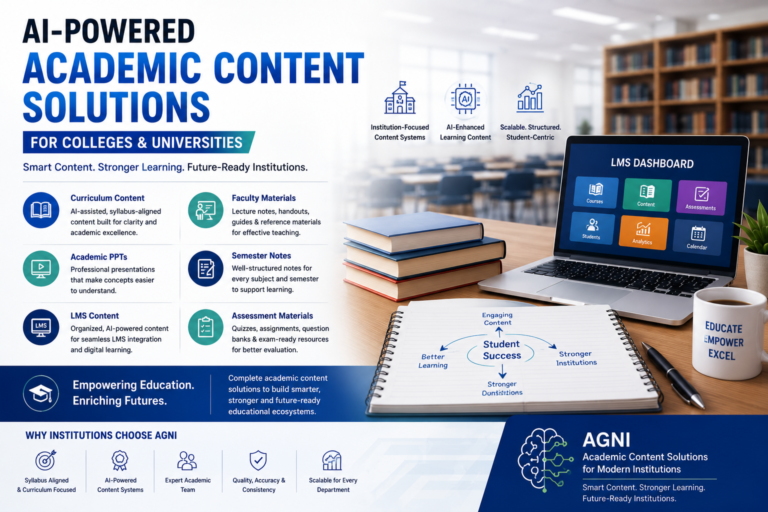
The Future of Education Is Becoming Digital and AI-Driven
Educational institutions are rapidly transforming the way they create, manage, and deliver academic content. Colleges, universities, and digital learning platforms are now adopting AI-powered academic systems to improve learning experiences, organize educational workflows, and build scalable content infrastructure for modern students.
Searches related to “AI in education,” “LMS content development,” “digital learning systems,” “curriculum content services,” and “AI-powered academic infrastructure” are growing globally as institutions move toward technology-enabled education systems.
Today, educational organizations are not only looking for study materials. They are searching for structured academic ecosystems that can support online learning, faculty workflows, learning management systems, assessments, presentations, and future-ready digital education environments.
Why Traditional Academic Content Systems Are Struggling
Many educational institutions still rely on outdated manual systems for content creation, faculty materials, semester notes, assessments, and classroom resources. These traditional workflows often create inconsistency, delayed content delivery, and difficulties in managing large-scale academic infrastructure.
At the same time, modern students expect:
- digital accessibility
- structured learning systems
- organized educational resources
- interactive content
- flexible online learning experiences
Universities and colleges are now under pressure to modernize their academic systems while maintaining quality, consistency, and scalability across departments and programs.
This shift is pushing institutions toward AI-assisted learning ecosystems and organized academic content management systems.
How AI Is Transforming Institutional Learning Systems
Artificial intelligence is helping educational institutions improve content organization, curriculum development, and digital learning delivery. AI-assisted workflows can support the creation of semester notes, faculty presentations, LMS content, assessments, learning modules, and structured academic documentation more efficiently.
Instead of replacing educators, AI is helping institutions simplify repetitive academic workflows while allowing faculty members to focus more on teaching quality, research, and student engagement.
At AGNI, institutional content systems are developed through a combination of:
- curriculum-focused planning
- AI-assisted organization
- human-reviewed refinement
- structured educational workflows
- scalable digital content systems
This helps institutions create more organized, accessible, and future-ready learning environments.
The Growing Importance of LMS and Digital Learning Infrastructure
Learning Management Systems have become one of the most important components of modern education. Colleges and universities are increasingly investing in LMS platforms to support online learning, hybrid classrooms, faculty coordination, and centralized academic management.
However, technology alone is not enough. Institutions also require:
- structured LMS content
- faculty teaching materials
- organized assessments
- presentation systems
- curriculum-aligned academic resources
Without proper academic content infrastructure, even advanced learning systems fail to create effective educational experiences.
AI-assisted educational workflows are helping institutions develop scalable content systems that support both classroom-based and digital learning environments.
AI-Synced Academic Content and Scalable Education Systems
Modern institutions are now exploring AI-synced educational ecosystems where content creation, student learning, faculty resources, and academic workflows work together in a more organized way.
This includes:
- curriculum-aligned learning modules
- AI-assisted educational documentation
- structured semester resources
- scalable faculty support systems
- digital academic presentations
- centralized knowledge systems
As education becomes increasingly digital, institutions that invest in organized academic infrastructure will be better prepared for the future of learning and educational technology.
Ethical AI in Education and Academic Systems
As AI adoption grows in educational institutions, academic ethics and responsible AI integration are becoming essential.
AI should improve accessibility, productivity, and educational efficiency without compromising originality, teaching quality, or intellectual responsibility.
At AGNI, we follow a research-driven and ethics-focused approach where every institutional workflow combines technology with human expertise, structured review systems, and professional educational standards.
Our goal is to help institutions build responsible and future-ready academic ecosystems rather than mass-produced automated systems.
The Future of AI in Colleges and Universities
The future of higher education will increasingly depend on AI-powered academic systems, digital learning infrastructure, intelligent educational workflows, and scalable content ecosystems.
Institutions worldwide are investing in:
- AI-assisted learning systems
- smart classroom environments
- digital curriculum management
- intelligent academic documentation
- centralized educational content systems
Educational organizations that combine technology with structured academic planning will have a major advantage in the evolving education landscape.
Conclusion
AI-powered academic systems are transforming how colleges, universities, and educational institutions create and manage learning environments.
From LMS content and faculty materials to curriculum development and digital academic infrastructure, institutions are moving toward organized, scalable, and technology-enabled educational ecosystems.
However, the future of education is not about replacing teachers with AI. It is about building smarter systems that improve learning quality, content accessibility, and academic organization while maintaining educational ethics and human-centered teaching practices.
AGNI supports this transformation through AI-assisted and professionally structured institutional content solutions designed for modern educational ecosystems.
Need Institutional Academic Content Support?
AGNI provides curriculum content development, LMS content systems, faculty materials, semester resources, academic presentations, and AI-assisted educational workflows designed for colleges, universities, and digital learning platforms.
Reference Sources
AI in Education & Digital Learning Trends
UNESCO Digital Education & AI
Research on AI in Higher Education
Frontiers in Education Research
Learning Management System & EdTech Insights
EdTech Magazine